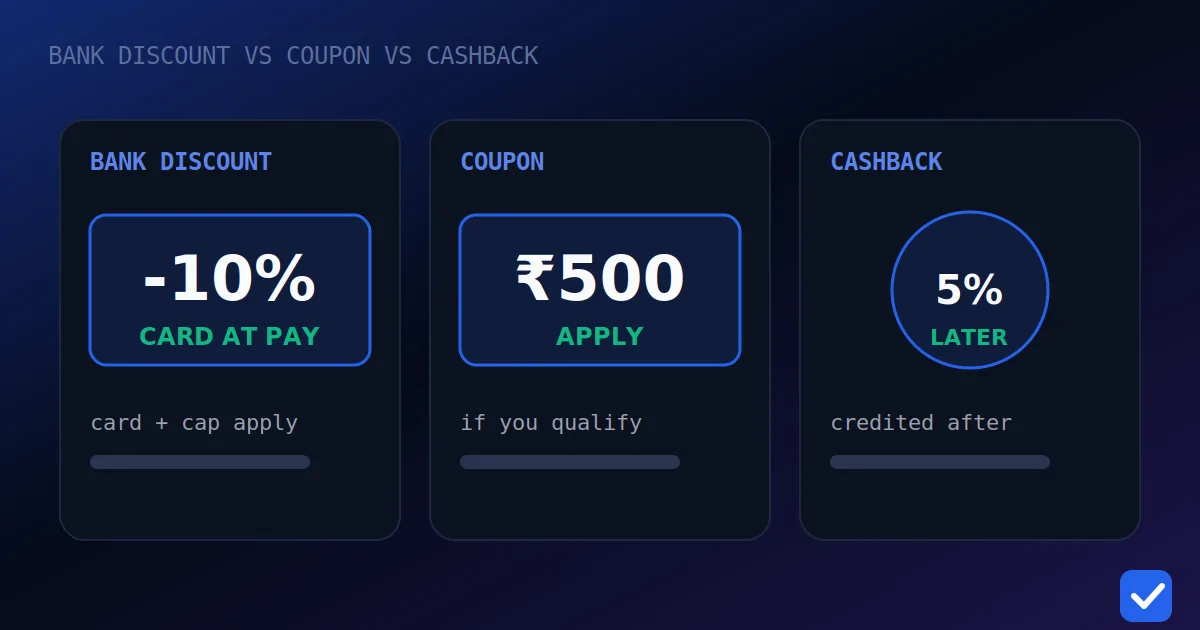
During a big sale, a product page may promise a bank offer, a coupon and cashback all at once. It is tempting to add them up and announce a huge total saving. That total is usually wrong, because the three work in different ways.
This guide explains each one, when it lowers what you pay, and how to put them together honestly. All numbers are made up to show the method.
Key takeaway: only count what reduces today's payment and that you can actually claim. Treat anything credited later as a separate, smaller-confidence bonus.
The Three Types, in Plain Words
| Type | When it helps | Usually depends on |
|---|---|---|
| Instant bank discount | Reduces the amount charged at payment | A specific card or bank, minimum spend, a maximum discount |
| Coupon | Reduces the price when applied or clipped | The product, a code or a clip, and its own conditions |
| Cashback or reward | Credited after the purchase, as money, balance or points | The payment method, a delay, expiry and where you can use it |
The first two change what you pay now. The third changes what you get back later. Mixing them into one "saving" overstates the position unless you are sure you will receive and use the cashback.
Instant Bank Discounts
An instant discount is taken off at the payment step when you use an eligible card. It is real money off today, but it comes with strings: eligible cards only, often a minimum order, and a cap on the rupee amount. A 10% offer capped at ₹1,000 is worth ₹1,000 on a ₹10,000 order but still ₹1,000 on a ₹50,000 order, which is 2%.
Only count it if you would use that card anyway. Opening a new card or changing how you pay purely for a discount is a different decision from judging the product's price.
Coupons
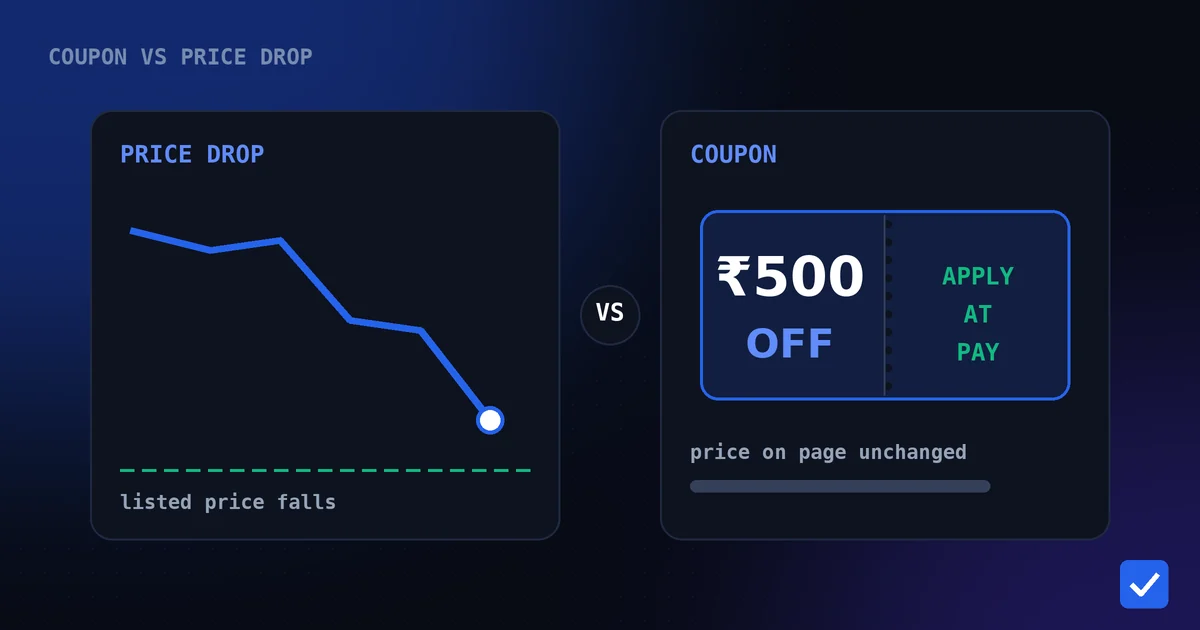
A coupon reduces the price under its own conditions. Some are clipped on the product page, some need a code, and some apply only to certain variants. A coupon can change the amount you pay without changing the listed price, which is why a product's price can look unchanged. Coupon vs price drop covers how to compare a coupon with a lower listed price.
Check that the coupon is applied on the payment screen. If it is not showing in the total, it is not part of your price.
Cashback and Rewards
Cashback is credited later. It might be returned to a wallet, a card statement or a points balance, and each has rules: when it arrives, whether it expires, and what it can be spent on. Points such as shop-specific coins are rewards, not instant money off.
That does not make cashback worthless. It is a real benefit if you will use it. But it belongs in a separate line from the amount you pay now.
A Worked Example (Hypothetical Numbers)
| Line | Amount | How to count it |
|---|---|---|
| Sale price | ₹20,000 | What the page shows |
| Coupon | −₹1,000 | Count it only if applied at checkout |
| Instant bank discount (10%, cap ₹1,500) | −₹1,500 | Count it only on an eligible card you would use |
| Amount you pay today | ₹17,500 | Your real payable amount |
| Cashback (5%) | +₹875 later | Count separately, and only if you will use it |
In this made-up example, you pay ₹17,500 today. If the 5% cashback is calculated on what you pay, the effective cost is roughly ₹16,625 once you have received and used it. Say "₹17,500 today, ₹875 back later" rather than "₹3,375 off". If only the card applied (no coupon), you would pay ₹18,500 today.
How to Find Your Real Saving
- Start with the price you would have paid without any offer, ideally a recent typical price for the exact product.
- Subtract only the offers that lower today's payment and that you qualify for.
- Compare that amount with your recent-price reference. That is your saving today.
- Then note cashback and rewards separately.
- Check the final payable amount on the payment screen before you confirm.
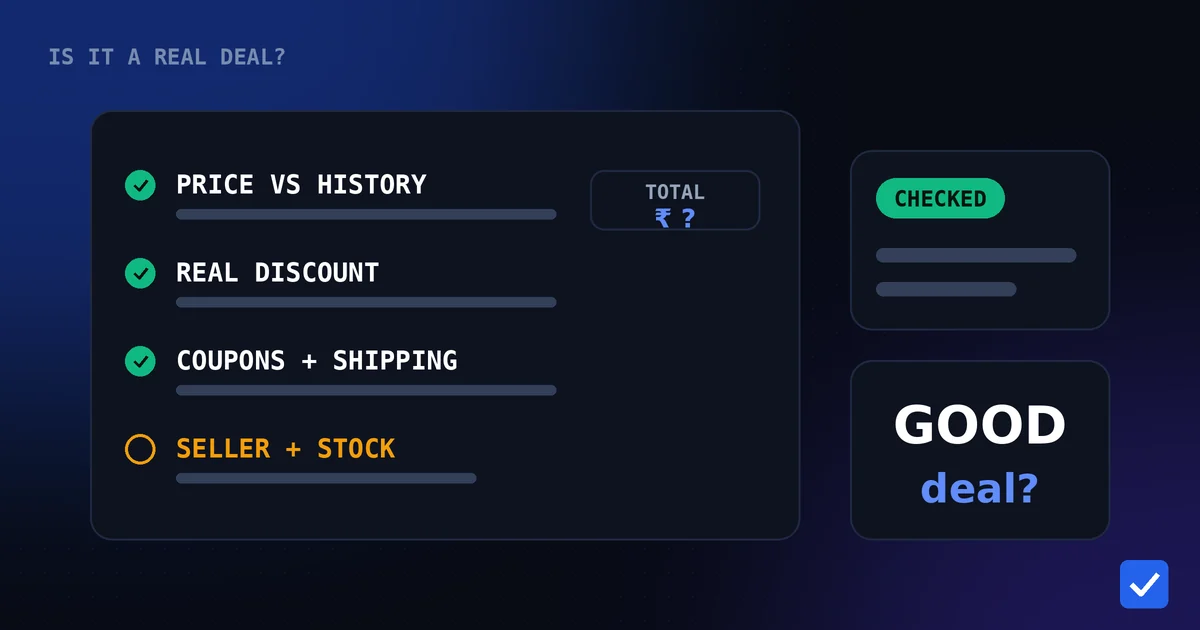
The Savings Calculator and Shopping Cost Calculator do the arithmetic, and the sale savings guide has more worked examples. For the bigger picture, see how to know if an online deal is actually good.
Why This Matters During Big Sales
Major festive sales stack many offers on top of each other. Both Amazon and Flipkart describe card offers, EMI options and rewards, each with its own terms. Our 2026 sales hub shows what each marketplace has said, labelled by type, and how to compare the same product on both.
A tracker can tell you when the listed price changes, but it cannot see which card offer or coupon applies to you. DealTrackerProBot alerts you on price drops and at target prices for supported Amazon and Flipkart products, and on Amazon coupons where it detects one. Always confirm the final amount at checkout.
Related pages: Savings Calculator, Shopping Cost Calculator, 2026 Sales Hub, Coupon Alerts